Have you ever typed “presenter or presentor” into Google because both versions seem like they could be correct? You’re not alone. The two spellings look almost identical, but there is an important difference when it comes to standard English usage.
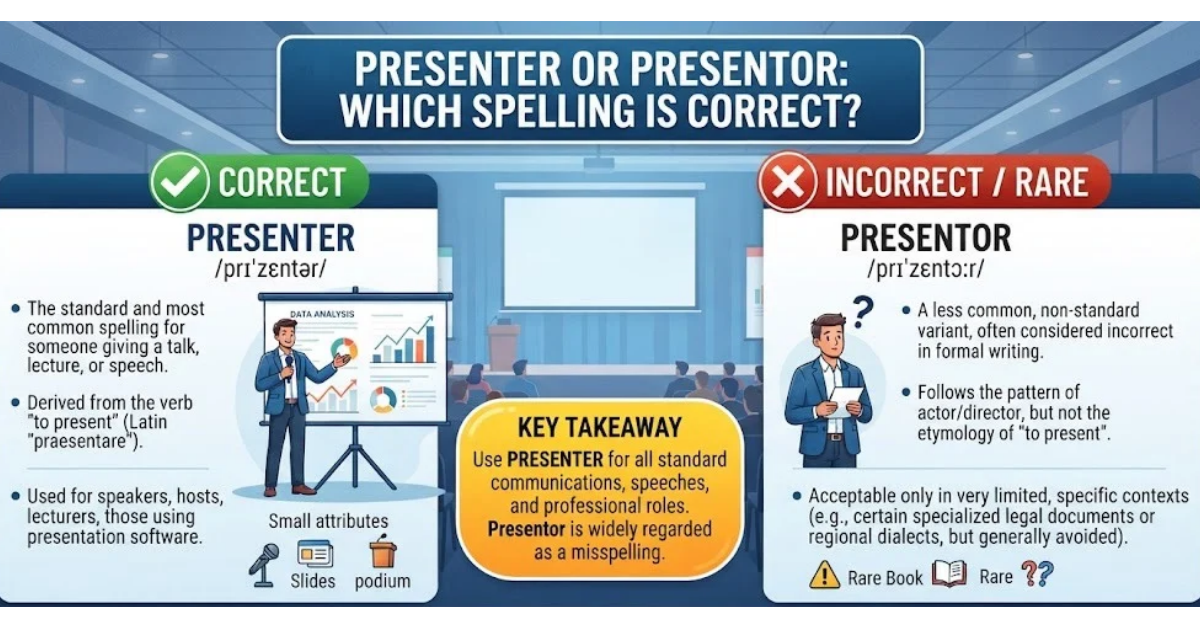
The correct and widely accepted spelling is presenter. While presentor occasionally appears in writing, it is uncommon and generally considered a nonstandard or less preferred variant. If you’re writing an email, résumé, academic paper, article, presentation, or professional profile, presenter is the safer choice.
Presenter or Presentor: Which One Is Correct?
Presenter is the standard English spelling.
A presenter is a person who presents something, such as information, a television program, an award, a product, or a speech.
For example:
- She is the presenter of a popular television program.
- Ahmed was the main presenter at the conference.
- The presenter explained the research findings clearly.
- Please contact the event presenter for more information.
Although presentor can be found occasionally, it is far less common and is generally not the preferred spelling in modern standard English.
Quick answer
| Word | Standard usage? | Recommendation |
| Presenter | Yes | Use it |
| Presentor | Uncommon/nonstandard in most contexts | Usually avoid it |
So, if you’re wondering “presenter or presentor?”, choose presenter in almost every ordinary English context.
Why Is “Presenter” the Correct Spelling?
The answer becomes easier to understand when you look at how English forms nouns from verbs.
The verb is present, meaning to show, introduce, explain, deliver, or formally give something.
English commonly forms a noun for a person who performs an action by adding -er to the verb:
- teach → teacher
- write → writer
- speak → speaker
- drive → driver
- present → presenter
Therefore:
present + er = presenter
The spelling presenter follows a familiar English word-formation pattern.
What Does Presenter Mean?
The noun presenter generally means a person who presents something.
The exact meaning depends on the context.
1. A television or radio presenter
In British English and many other varieties of English, a television or radio host is often called a presenter.
For example:
The television presenter interviewed several international celebrities.
In American English, host is often more common in this context, although presenter is still understood.
2. A person giving a presentation
A presenter can also be someone speaking to an audience about a particular subject.
For example:
The conference presenter discussed recent developments in artificial intelligence.
Here, the presenter is the person delivering the presentation.
3. Someone formally giving an award or item
The word can also describe a person who presents something to another person.
For example:
The presenter handed the award to the winner.
This usage is less common in everyday conversation but is perfectly understandable.
4. A person demonstrating information or ideas
In business, education, and professional settings, a presenter may explain research, introduce a product, demonstrate software, or share proposals.
For example:
The sales presenter demonstrated the company’s new software.
Is “Presentor” a Word?
This is where things get slightly more complicated.
Presentor can be found in some dictionaries, documents, and online writing, but it is much less common than presenter. Its existence in occasional usage does not make it the preferred spelling for most modern English contexts.
In standard professional writing, presenter is overwhelmingly the safer choice.
Think of it this way:
Presenter = normal, established, widely preferred spelling
Presentor = uncommon variant that is generally best avoided
If your goal is clear, polished English, there is little reason to choose presentor when presenter is available.
Presenter vs. Presentor: The Main Difference
The biggest difference is not meaning but usage and acceptability.
Both forms are intended to describe someone who presents. However, presenter is the conventional form used in dictionaries, professional communication, broadcasting, education, and everyday English.
Presentor may appear because English speakers sometimes assume that present should take the suffix -or, as in words such as:
- actor
- editor
- instructor
- administrator
- translator
But English does not always form agent nouns according to a single predictable rule.
That is why presenter, rather than presentor, became the standard form.
Why Do People Spell It “Presentor”?
The confusion is understandable.
English has several common nouns ending in -or, so it may seem logical to write presentor. For example:
- supervise → supervisor
- operate → operator
- educate → educator
- inspect → inspector
However, English also frequently uses -er:
- teach → teacher
- manage → manager
- design → designer
- produce → producer
- present → presenter
There is no universal rule saying that every person who performs an action must be described using -er or -or. Many of these forms developed historically, so the correct spelling often has to be learned as part of normal vocabulary.
Presenter in British and American English
Presenter is used in both British and American English, although the surrounding terminology can differ.
In British English, presenter is particularly common for someone who hosts a television or radio program.
For example:
The BBC presenter interviewed the actor.
In American English, host is often preferred for television and radio personalities:
The TV host interviewed the actor.
However, presenter remains a valid English word in American usage, especially when discussing conferences, presentations, awards, or formal events.
Presenter Examples in Sentences
Here are several natural examples showing how presenter can be used:
- The presenter began the conference with a short introduction.
- She works as a television presenter.
- The presenter explained the results using several charts.
- Each presenter has 15 minutes to speak.
- The award presenter congratulated the winner.
- The conference organizers introduced the next presenter.
- He is an experienced corporate presenter.
- The radio presenter welcomed listeners to the morning show.
These examples demonstrate why presenter works naturally across broadcasting, education, business, and public speaking.
Presenter vs. Presenter’s vs. Presenting
It is also useful to distinguish presenter from related words.
Presenter
A presenter is the person doing the presenting.
The presenter answered questions from the audience.
Presenter’s
Presenter’s is the possessive form.
The presenter’s slides were easy to understand.
Here, the slides belong to or are associated with the presenter.
Presenting
Presenting is the -ing form of the verb present.
She is presenting the proposal tomorrow.
These words are related but serve different grammatical purposes.
Common Mistakes With “Presenter”
The most common mistake is simply using presentor when presenter is intended.
For example:
He was the main presentor at the meeting.
Better:
He was the main presenter at the meeting.
Another common issue is confusing the person with the presentation itself.
For example:
The presenter was very informative.
This can be grammatically correct if you’re talking about the person, but if you mean the content, you might say:
The presentation was very informative.
Remember:
- Presenter = the person
- Presentation = the event, talk, or material being presented
- Present = the verb
- Presenting = the act of giving the presentation
Presenter vs. Presentation
These two words are especially easy to confuse because they come from the same root.
A presentation is something that is presented, usually a speech, talk, demonstration, or set of information.
A presenter is the person who delivers it.
For example:
The presenter gave an excellent presentation.
This sentence uses both words correctly.
Other examples include:
The presenter prepared the presentation carefully.
The presentation was informative, but the presenter spoke too quickly.
Is “Presentor” Ever Acceptable?
If you’re writing formal or professional English, presenter should generally be your choice.
You may encounter presentor in older documents, specialized writing, informal online content, or texts written by people who have adopted the spelling independently. Its appearance does not necessarily mean the writer intended an entirely different meaning.
However, if you are preparing:
- a résumé or CV
- a cover letter
- an academic paper
- a business report
- a website
- a presentation
- a professional biography
- marketing material
- a formal email
then presenter is the conventional choice.
How to Remember the Correct Spelling
A simple trick is to connect presenter with other familiar -er words.
Think:
teach → teacher
write → writer
speak → speaker
present → presenter
You can also remember the distinction this way:
A presenter presents.
The ending -er directly identifies the person performing the action.
Synonyms for Presenter
Depending on the situation, several other words may work instead of presenter.
For television or radio
- host
- broadcaster
- announcer
- anchor
For conferences or public speaking
- speaker
- lecturer
- facilitator
- moderator
For business presentations
- speaker
- demonstrator
- spokesperson
- representative
These words aren’t always exact synonyms, though. A moderator, for example, typically guides a discussion rather than delivering the main presentation.
Presenter or Presentor in a Resume or CV
If you’re describing presentation experience on a résumé or CV, use presenter.
For example:
Conference Presenter — Presented research findings to an audience of more than 200 professionals.
Or:
Experienced presenter with a background in corporate training and public speaking.
Using presentor in a professional résumé could distract readers because it looks like a spelling error.
Presenter or Presentor in Academic Writing
Academic writers should also use presenter.
For example:
The presenter discussed the study’s methodology before answering questions.
If you’re describing a conference program, you might see:
Presenter: Dr. Sarah Khan
Presentation: Advances in Environmental Science
This distinction makes the roles immediately clear.
A Simple Rule to Follow
If you’re unsure whether to write presenter or presentor, follow this rule:
Use “presenter.”
It is the standard and widely recognized spelling for a person who presents something.
You generally do not gain anything by choosing presentor, while choosing presenter ensures your writing sounds natural and professional.
Quick Comparison: Presenter vs. Presentor
| Feature | Presenter | Presentor |
| Standard English | Yes | Generally not preferred |
| Common in modern writing | Very common | Rare |
| Used in broadcasting | Yes | Rare |
| Used for conferences | Yes | Rare |
| Recommended for professional writing | Yes | No |
| Meaning | Person who presents | Intended to mean a person who presents |
Frequently Asked Questions
Is “presenter” or “presentor” correct?
Presenter is the standard and preferred spelling. Presentor is uncommon and is generally best avoided in formal and professional English.
Is presentor an incorrect word?
Presentor does appear in English-language sources, but it is much less common than presenter and is generally not the preferred form. For standard modern writing, use presenter.
What is a person who gives a presentation called?
A person who gives a presentation is called a presenter or speaker. The most appropriate term depends on the context.
What is the difference between a presenter and a presentation?
A presenter is the person who delivers or gives information. A presentation is the talk, demonstration, or material being delivered.
For example:
The presenter gave an informative presentation.
Is “presenter” correct in American English?
Yes. Presenter is used in American English, particularly for people giving presentations. In television and radio, however, host may be more common in American usage.
Is “presenter” correct in British English?
Yes. Presenter is very common in British English, especially for television and radio personalities as well as people who give presentations.
Why do people write “presentor”?
The spelling probably results from analogy with other English words ending in -or, such as operator, administrator, and instructor. However, the established form for someone who presents is presenter.
What is the plural of presenter?
The plural is presenters.
For example:
The conference featured several international presenters.
What is the possessive form of presenter?
The singular possessive is presenter’s.
For example:
The presenter’s microphone stopped working.
The plural possessive is presenters’.
For example:
The presenters’ schedules were published online.
Final Verdict: Presenter or Presentor?
When deciding between presenter or presentor, the answer is straightforward: presenter is the correct and preferred choice in standard modern English.
Although presentor can occasionally be found, it is uncommon and may look like a spelling mistake to many readers. Whether you’re writing a résumé, academic paper, website, business document, or everyday message, presenter is the word to use.
The easiest way to remember it is simple: a person who presents is a presenter.