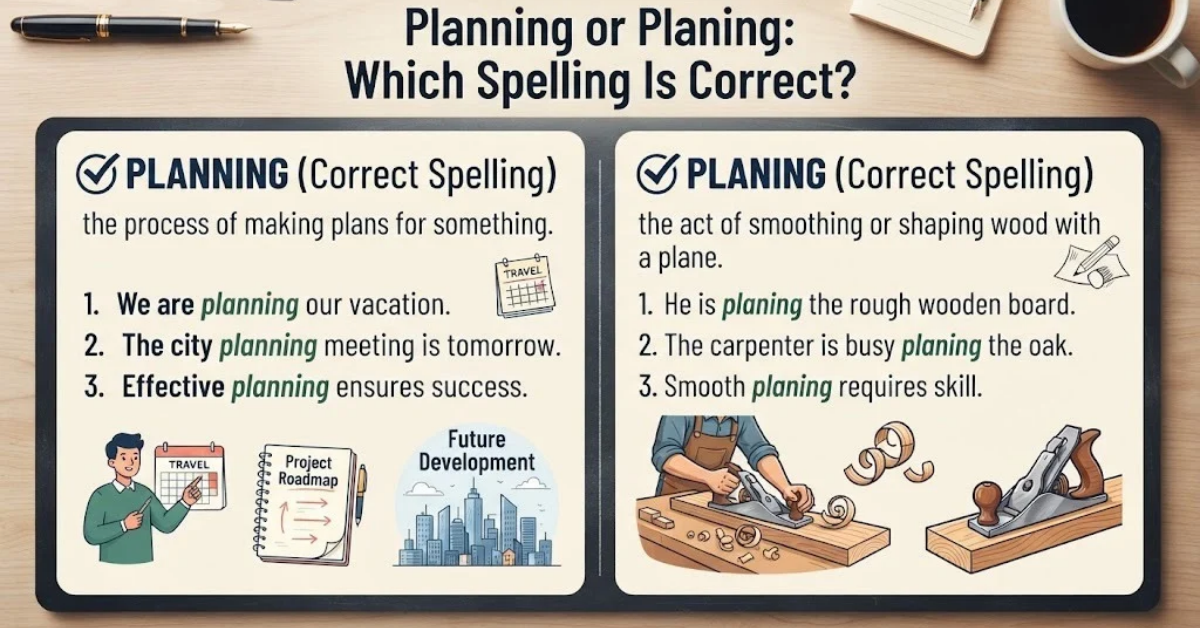
Have you ever typed “planning or planing” and wondered which spelling is correct? You are not alone. The two words look almost identical, but they have completely different meanings and are used in very different situations.
In everyday English, planning is almost always the word you want when talking about preparing for something, organizing an activity, or deciding what you will do in the future. Planing, with one “n,” is a real English word too, but it is much less common and belongs mainly to woodworking and boat-related contexts.
Understanding the difference between planning or planing is simple once you know the rule. This guide explains both words, shows how they are used, and provides practical examples to help you remember the correct spelling.
Planning or Planing: What Is the Difference?
The easiest way to understand the difference is to look at their meanings:
- Planning = making arrangements or deciding what to do.
- Planing = smoothing or shaping a surface with a plane, or moving across water in a particular way.
So, if you are talking about a trip, project, event, career, meeting, or future activity, the correct spelling is generally planning.
Planning Meaning
Planning is the present participle or gerund form of the verb plan. It means thinking ahead and making decisions about what needs to be done.
For example:
We are planning a family vacation for December.
Here, “planning” refers to organizing the vacation.
Other examples include:
- She is planning her wedding.
- They are planning to launch a new business.
- I am planning a meeting for Monday.
- He spent the weekend planning his next project.
- We are planning how to improve the website.
In each example, planning describes preparation, organization, or future decision-making.
Why Is Planning Spelled With Two Ns?
The spelling can seem confusing because the base word is plan, which has only one “n.”
The reason is a standard English spelling rule. When a one-syllable verb ends in a consonant-vowel-consonant pattern and you add a suffix beginning with a vowel, the final consonant is often doubled.
The word plan follows this pattern:
plan + ing → planning
The final n is doubled, producing planning.
You can see a similar pattern in other English words:
- run → running
- sit → sitting
- stop → stopping
- swim → swimming
- begin → beginning
This is why planing is not normally the correct spelling when you mean “making plans.”
Planing Meaning
Although planing is much less common, it is a legitimate English word.
It comes from the verb plane, which means to smooth, flatten, or shape a material—especially wood—using a tool called a plane.
For example:
The carpenter is planing the wooden board.
In this sentence, “planing” means removing thin layers of wood to create a smooth or accurately shaped surface.
You might also encounter planing in boating and aviation-related contexts. A boat can be described as planing when it moves rapidly across the surface of the water, with much of its hull lifted above the water.
For example:
The speedboat was planing across the lake.
Therefore, planing is correct in specific technical contexts, but it does not mean “making plans.”
Planning vs. Planing Examples
Seeing the two words side by side makes the distinction easier to remember.
| Word | Meaning | Example |
| Planning | Preparing or organizing something | We are planning a trip. |
| Planing | Smoothing or shaping material | The carpenter is planing the wood. |
| Planning | Thinking ahead | She is planning her career. |
| Planing | Moving rapidly over water | The boat is planing across the lake. |
The key difference is the base verb:
Plan → planning
Plane → planing
That one extra e changes the meaning completely.
Is “Planning” or “Planing” Correct?
If you are asking which spelling to use in ordinary conversation or writing, planning is almost certainly correct.
Use planning when you mean:
- preparing
- organizing
- arranging
- scheduling
- deciding in advance
- thinking about future actions
Use planing when you mean:
- smoothing wood with a plane
- shaping a surface with a plane
- a boat moving rapidly across the water
A useful question to ask yourself is:
“Am I making a plan, or am I using a plane?”
If you are making a plan, use planning.
If you are using a plane as a tool, use planing.
Common Examples of Planning
The word planning appears in countless everyday situations.
Planning a Trip
We are planning a trip to the mountains next month.
Here, the person is making arrangements for future travel.
Planning an Event
The team is planning a conference for next year.
This means the team is organizing the event.
Planning a Project
Good planning can help a project stay on schedule.
In this case, planning refers to preparing tasks, resources, deadlines, and responsibilities.
Planning for the Future
Financial planning can make it easier to manage long-term goals.
This refers to preparing financially for future needs.
Planning to Do Something
The structure planning to + verb is also extremely common.
Examples:
- I am planning to study tonight.
- She is planning to move next year.
- They are planning to open a restaurant.
- We are planning to visit our relatives.
Common Examples of Planing
Because planing is a specialized word, you are more likely to encounter it in technical writing than in everyday conversation.
Woodworking
The carpenter is planing the surface of the table.
Here, planing means smoothing the wood.
Boat Movement
The boat began planing as it reached a higher speed.
In boating terminology, planing describes a type of high-speed movement in which the vessel rides largely on top of the water rather than moving through it in the same way as a displacement vessel.
Planning or Planing: Common Mistakes
One of the most common spelling mistakes is writing “planing” when the intended meaning is “making plans.”
For example:
Incorrect for ordinary planning:
I am planing my vacation.
Correct:
I am planning my vacation.
The second n is important because it identifies the word as the form of plan.
Another common mistake is assuming that every verb simply adds “-ing” without changing its spelling. English spelling rules are not always intuitive, so remembering the base word can help.
A Simple Memory Trick
Think of the two base words:
PLAN + ING = PLANNING
PLANE + ING = PLANING
If the original word is plan, double the n.
If the original word is plane, remove the final e before adding -ing.
Planning in Different Contexts
The word planning is useful in almost every area of life and work.
Business Planning
Businesses use planning to establish goals, budgets, timelines, marketing strategies, and operational priorities.
Examples include:
- business planning
- strategic planning
- financial planning
- marketing planning
- project planning
- workforce planning
Academic Planning
Students may use planning to organize their studies, assignments, examinations, and long-term academic goals.
Effective study planning can reduce last-minute stress.
Travel Planning
Travel planning can involve choosing destinations, booking transportation, arranging accommodation, and creating an itinerary.
Careful travel planning can make a trip smoother and more enjoyable.
Personal Planning
People also use planning for everyday responsibilities and long-term goals.
Examples include:
- meal planning
- retirement planning
- wedding planning
- career planning
- budget planning
- time planning
Why Correct Spelling Matters
A spelling error may seem minor, but using the wrong word can change the meaning of a sentence.
Compare these:
We are planning the renovation.
This clearly means that we are organizing or preparing for the renovation.
Now consider:
We are planing the renovation.
This sounds as though we are physically smoothing or shaping something with a plane, which is probably not what the writer intended.
Correct spelling improves clarity and makes your writing easier to understand. This is especially important in professional emails, academic assignments, business documents, websites, and formal communication.
How to Remember Planning vs. Planing
If you frequently confuse these words, use this simple three-step method:
- Identify the base word.
Are you starting with plan or plane? - Check the meaning.
Are you organizing something or smoothing/shaping something? - Choose the spelling.
- Plan → planning
- Plane → planing
A quick memory sentence is:
I am planning my project, but the carpenter is planing the wood.
Once you associate the extra n with the word plan, the spelling becomes much easier to remember.
Planning or Planing in a Sentence
Here are several quick examples for comparison:
Planning
- She is planning a birthday party.
- We are planning our next vacation.
- They spent several weeks planning the project.
- He is planning to start a new course.
- Careful planning is essential for success.
Planing
- The carpenter is planing the wooden door.
- He used a hand plane for planing the board.
- The speedboat was planing across the water.
These examples demonstrate why context matters. Both spellings are valid, but they belong to different meanings and situations.
Frequently Asked Questions
Is “planning” or “planing” correct?
Both are correct English words, but they have different meanings. Planning means preparing or organizing something, while planing generally means smoothing or shaping a surface with a plane or describes certain types of movement across water.
Is it “planning” with one N or two?
The correct spelling is planning, with two n letters, when it comes from the verb plan.
For example:
We are planning a meeting.
Why does planning have two Ns?
The final consonant of plan is doubled when the suffix -ing is added. Therefore:
plan + ing = planning
What does planing mean?
Planing is the present participle of plane. It can refer to smoothing or shaping material, particularly wood, with a plane. In boating, it can also describe a vessel moving rapidly across the surface of the water.
Is “planing a trip” correct?
No, not when you mean organizing a trip. The correct expression is:
planning a trip
For example:
We are planning a trip to Lahore.
Is “planning to” grammatically correct?
Yes. Planning to + base verb is a standard English construction used to describe an intention or future action.
Examples:
- I am planning to travel.
- She is planning to study abroad.
- They are planning to expand the business.
What is the difference between plan and plane?
Plan can mean an intention, arrangement, or strategy. Plane can refer to a flat surface, an aircraft, or a woodworking tool. Their -ing forms are therefore different:
- plan → planning
- plane → planing
Which is more common: planning or planing?
Planning is far more common in everyday English because people frequently discuss preparing, organizing, and making future arrangements. Planing is mainly used in specialized contexts such as woodworking and boating.
Final Takeaway: Planning or Planing?
The difference between planning or planing comes down to both spelling and meaning.
If you mean organizing, preparing, or deciding what to do, use planning:
We are planning our next vacation.
If you mean smoothing or shaping something with a plane, use planing:
The carpenter is planing the wooden board.
The easiest rule to remember is simple: plan → planning, while plane → planing. When you’re talking about goals, schedules, trips, projects, events, or future decisions, planning is almost always the word you need.
Once you understand the base word and meaning, this commonly confused pair becomes much easier to use correctly.