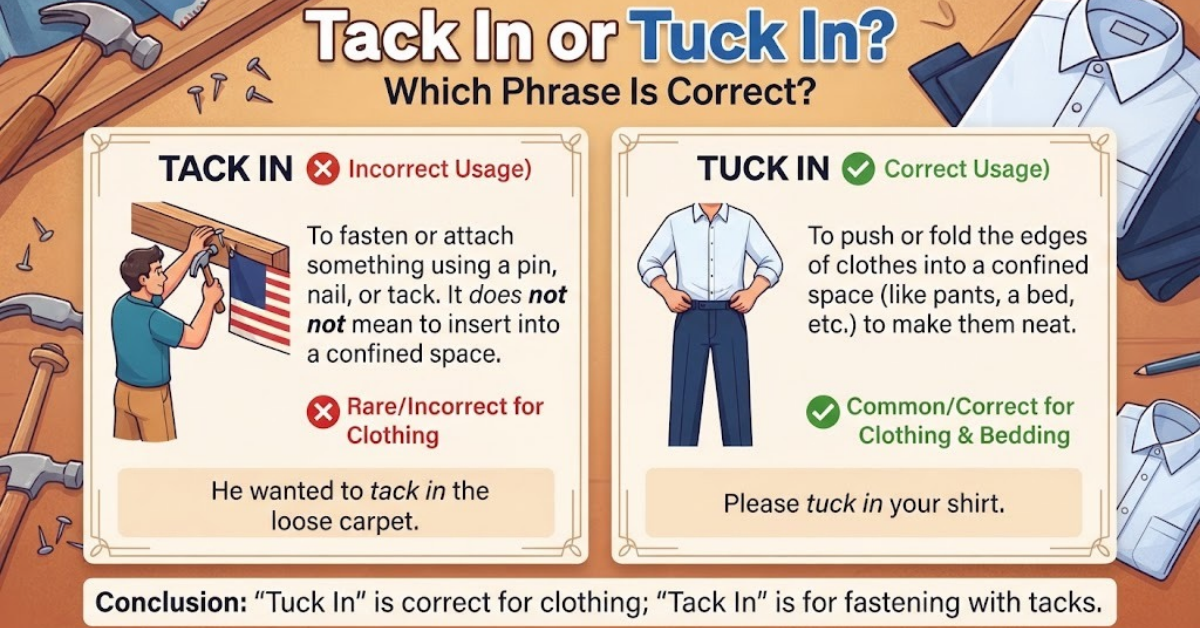
Have you ever written “tack in” when you meant “tuck in”? You’re not alone. These two expressions sound similar, but they have different meanings, and only one is normally correct when you’re talking about putting something neatly inside or under something else.
So, should you say “tack in or tuck in”? In most everyday situations, the correct phrase is “tuck in.” However, “tack” is also a real English word with several meanings, which is why the confusion is understandable.
This guide explains the difference between tack in and tuck in, what each expression means, how to use them correctly, and examples you can use in everyday conversation and writing.
Tack In or Tuck In: Which One Is Correct?
If you mean to put something into a particular place, fold it underneath something, or make it neat and secure, the correct expression is usually “tuck in.”
For example:
- Tuck in your shirt before the meeting.
- She tucked the blanket around the child.
- He tucked the loose end of the fabric in.
The phrase “tack in” does exist in certain specialized contexts, but it does not normally replace “tuck in” in these everyday sentences.
Quick answer
| Phrase | Common meaning | Correct for putting something neatly inside? |
| Tuck in | Put, fold, or push something into a particular position | Yes |
| Tack in | Fasten temporarily, or use “tack” in a specialized sense | Usually no |
Therefore, if you’re wondering whether to write “tack in or tuck in,” choose “tuck in” when referring to folding, inserting, or securing something neatly.
What Does “Tuck In” Mean?
Tuck in is a phrasal verb with several related meanings. At its most basic, it means to put something into a neat or secure position, often by folding or pushing part of it underneath something else.
For example:
She tucked the shirt into her trousers.
Here, the shirt is being pushed or folded inside the trousers to create a neat appearance.
You can also tuck something into a bag, pocket, bed, drawer, or another suitable space:
- Tuck the letter into the envelope.
- He tucked his phone into his pocket.
- She tucked the blanket around her daughter.
The word can also describe putting someone comfortably into bed.
The mother tucked her child in before going downstairs.
In this sense, “tuck someone in” means to make them comfortable in bed, usually by arranging the blankets around them.
What Does “Tack In” Mean?
The word tack has a different meaning from tuck.
As a verb, tack can mean to fasten something temporarily using a tack, pin, or similar object.
For example:
He tacked the fabric to the wall.
In this sentence, “tacked” means temporarily attached or fastened.
“Tack” also has specialized meanings in fields such as sailing. In sailing terminology, tack can refer to a particular direction or maneuver of a sailing vessel.
Because of these meanings, “tack in” may appear in technical or specialized writing. But it is not normally the phrase you want when you’re talking about putting clothes into trousers, arranging bedding, or placing something neatly inside another object.
Tuck In vs. Tack In: The Main Difference
The easiest way to remember the difference is to associate tuck with folding or putting something neatly into place.
Think of these examples:
- Tuck in your shirt.
- Tuck the blanket around the baby.
- Tuck the paper into the folder.
On the other hand, think of tack as relating to fastening or attaching something, especially temporarily.
- Tack the poster to the wall.
- Tack the fabric in place.
The two words may sound similar, but their meanings are quite different.
Tuck In Meaning in Different Contexts
The meaning of “tuck in” can change slightly depending on the context.
1. Tuck In Clothes
One of the most common uses is related to clothing.
Please tuck in your shirt.
This means to put the lower part of the shirt inside your trousers, skirt, or other clothing.
You might also hear:
- Tuck your shirt in.
- His shirt was neatly tucked in.
- She tucked her blouse into her skirt.
2. Tuck Someone Into Bed
“Tuck in” can also describe preparing someone for sleep.
Dad tucked me in before going to work.
This usually involves arranging blankets or bedding around someone so they are comfortable.
For example:
She tucked the children in and turned off the light.
3. Tuck Something Away
The related expression “tuck away” means to put something somewhere safe, hidden, or out of the way.
I tucked the documents away in a drawer.
It can also have a figurative meaning related to eating:
He tucked away a large dinner.
In informal English, this means he ate a lot of food or ate something enthusiastically.
4. Tuck Something Into Something
You can use “tuck” when putting one object into another.
She tucked the receipt into her wallet.
The idea is generally that the object is placed securely, neatly, or partly hidden.
Examples of “Tuck In” in Sentences
Here are some natural examples:
- Tuck in your shirt before the interview.
- She tucked the blanket around her son.
- He tucked the note into his pocket.
- I tucked the book under my arm.
- Please tuck the loose fabric inside.
- The waiter brought the food, and everyone tucked in.
- She tucked her hair behind her ear.
- He tucked the documents safely into his briefcase.
Notice that “tuck” often conveys the idea of placing something neatly, securely, or partly underneath something else.
What Does “Tuck In” Mean When Talking About Food?
There is another common use that can surprise English learners.
In informal English, particularly British English, “tuck in” can mean to start eating enthusiastically.
For example:
The food is ready, so tuck in!
Here, nobody is folding or putting anything inside anything else. Instead, the speaker is encouraging people to begin eating.
You might hear:
- Dinner’s ready. Tuck in!
- Everyone tucked in as soon as the food arrived.
- We had a huge meal and really tucked in.
This use is especially common in British English and other varieties influenced by British usage.
Is “Tack In” Ever Correct?
Yes, but it depends on the context.
“Tack” is a legitimate English word, so it would be incorrect to claim that “tack in” can never appear.
For example, in a context involving temporarily fastening something, “tack” may be appropriate:
The tailor tacked the fabric in place before sewing it permanently.
However, if you are describing clothing being placed inside other clothing, you would normally say:
Tuck the shirt in.
Not:
Tack the shirt in.
The key is to consider the intended action rather than simply how the words sound.
Common Mistakes With “Tack” and “Tuck”
Because “tack” and “tuck” are only one vowel sound apart in many accents, they are easy to confuse.
Here are some common mistakes:
Incorrect for clothing
Tack your shirt in.
Correct
Tuck your shirt in.
She tacked the blanket around the baby.
Correct
She tucked the blanket around the baby.
She tacked the fabric to the board.
Here, “tacked” means temporarily fastened.
Tuck vs. Tack: A Simple Memory Trick
A simple way to remember the difference is:
TUCK = put or fold something into place.
TACK = fasten something temporarily.
Think of a shirt:
Tuck it in.
Think of a poster:
Tack it to the wall.
This simple distinction will help you choose the right word in most everyday situations.
Tuck In or Tuck It In?
Both forms can be correct, depending on the sentence.
“Tuck in”
Use this when the object is understood or when the phrase is being used without a specific object.
Tuck in your shirt.
“Tuck it in”
Use “it” when referring to a specific thing already mentioned.
Your shirt is hanging out. Tuck it in.
Here, “it” refers to the shirt.
You can also say:
Tuck the shirt in.
All three forms can be grammatically correct, but their sentence structures differ.
Tuck In or Tuck Into?
These expressions are closely related but aren’t always interchangeable.
Tuck in can mean placing something into a position:
Tuck your shirt in.
Tuck into is commonly used when identifying the thing or place something is being put into:
She tucked the letter into the envelope.
“Tuck into” can also have the food-related meaning of eating enthusiastically:
Everyone tucked into the meal.
The exact construction depends on what follows the verb.
Tuck In Synonyms
Depending on the context, several words can have a similar meaning to “tuck in.”
Possible alternatives include:
- Insert
- Put inside
- Fold
- Push in
- Secure
- Arrange
- Place
- Fasten
- Put away
- Cover
However, these aren’t perfect substitutes in every sentence. “Tuck” often carries the additional idea of making something neat, snug, or secure.
For example, “put the blanket around the child” describes the action, while “tuck the child in” sounds more natural when describing bedtime.
Why Do People Confuse “Tack” and “Tuck”?
The confusion largely comes from pronunciation and spelling.
Both words are short, begin with t, and contain the hard k sound at the end. In fast speech, particularly for people learning English, the difference between the vowel sounds can be difficult to hear.
Their meanings are also associated with physical actions, which can make context confusing.
The best solution is not to rely only on pronunciation. Remember the basic meanings:
- Tuck → put or fold neatly into place
- Tack → attach or fasten temporarily
“Tack In or Tuck In” in American and British English
The basic distinction between tack and tuck remains the same in both American and British English.
However, some uses of “tuck in” vary in frequency.
The expression meaning “start eating enthusiastically” is particularly common in British English:
Come on, everyone—tuck in!
American English speakers may understand this expression but may use other phrases more frequently, such as:
Dig in!
Both expressions can encourage someone to start eating.
Frequently Asked Questions
Is it “tack in” or “tuck in”?
In most everyday situations involving putting, folding, or pushing something neatly into place, the correct phrase is “tuck in.” “Tack” has a different meaning, usually involving temporary fastening or specialized terminology.
Is “tuck in” grammatically correct?
Yes. “Tuck in” is a common English phrasal verb. It can mean putting something into a particular position, making someone comfortable in bed, or, informally, starting to eat.
What does “tuck your shirt in” mean?
“Tuck your shirt in” means putting the lower part of your shirt inside your trousers, skirt, or another item of clothing.
What does “tack in” mean?
“Tack in” can occur in specialized contexts, but it is not the normal phrase for putting clothing or another object neatly inside something. The verb tack generally relates to fastening something temporarily or has specialized meanings, such as in sailing.
Is it “tuck in” or “tuck into”?
Both can be correct. “Tuck in your shirt” is standard when describing clothing. “Tuck the note into the drawer” identifies where something is being placed. “Tuck into” can also mean eating something enthusiastically.
What is the difference between tuck and tack?
Tuck generally means to put, fold, or push something neatly into place. Tack generally means to fasten something temporarily, although it has other technical meanings.
Can “tuck in” mean eat?
Yes. In informal English, particularly British English, “tuck in” can mean to start eating enthusiastically. For example, “Dinner’s ready—tuck in!”
Is “tack” related to “tuck”?
They are different words with different meanings. Their similar spelling and pronunciation can cause confusion, but one should not normally be substituted for the other.
Final Verdict: Tack In or Tuck In?
When you’re trying to say that something should be put, folded, or pushed neatly into place, the answer is “tuck in.”
Say:
- Tuck in your shirt.
- Tuck the blanket around the baby.
- Tuck the paper into the folder.
Use “tack” when you mean to fasten or attach something, particularly temporarily:
- Tack the fabric to the board.
- Tack the poster to the wall.
So, when you’re faced with the choice “tack in or tuck in,” remember the simple rule: tuck means put or fold into place; tack means fasten or attach. Once you know that distinction, choosing the right expression becomes much easier.